


The United Arab Emirates remains one of the most popular places in the world to work. Tax-free income, modern cities, and strong job markets in finance, technology, hospitality, and construction attract professionals from every corner of the globe. But before anyone can legally live and work there, they must complete the UAE employment visa process, a system that involves several government departments, medical checks, and paperwork.
This guide explains everything you need to know about UAE employment visas in 2026: the types available, who qualifies, the steps involved, the documents you’ll need, and how long the process usually takes.
What Is a UAE Employment Visa?
A UAE employment visa is a residence permit that lets a foreign national live and work legally for a UAE-based employer. The employer sponsors the visa, which means they take responsibility for the employee’s residency status and must follow UAE labor law throughout the working relationship. Without this visa, no one can legally earn a salary in the UAE whether in a private company, a government role, or a free zone.
Types of UAE Work Visas
Before looking at the process itself, it helps to know the main types of employment visas:
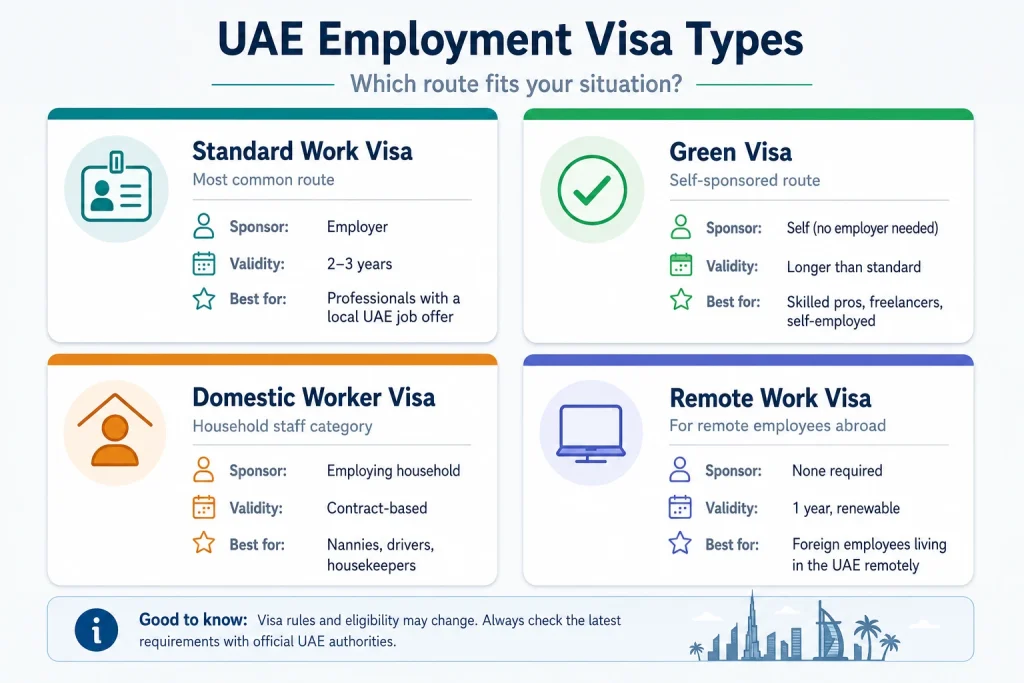
Standard Work Visa:
The most common type. An employer in the government or private sector sponsors the visa, and it’s tied to a specific job and company. The employee’s legal status depends on staying employed with that same sponsor.
Green Visa:
Built for skilled professionals, freelancers, and self-employed people. Instead of needing an employer to sponsor them, holders can sponsor themselves. This gives them more freedom, along with a longer visa validity period.
Domestic Worker Visa:
For household staff such as nannies, drivers, and housekeepers. It follows a different sponsorship process than professional employment visas.
Remote Work Visa:
For people employed by a company outside the UAE who want to live in the UAE while working remotely. This visa doesn’t need a local sponsor, but applicants must show proof of foreign employment and meet a minimum monthly income requirement.
Most people moving to the UAE for a local job use the standard employment visa, so the rest of this guide focuses on that route. Soharon Infotech partners with immigration consultants, relocation firms, and HR service providers to build the websites and digital marketing campaigns that help them reach employers and candidates going through this standard process.
Who Qualifies for a UAE Employment Visa?
Both the employer and the employee need to meet certain requirements:
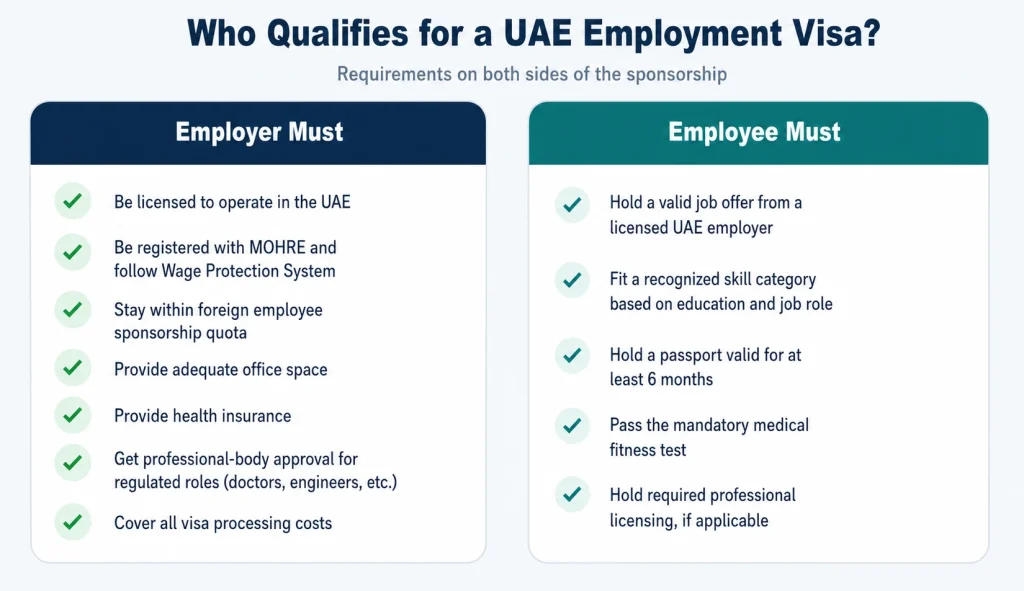
- The applicant needs a valid job offer from a company licensed to operate in the UAE, on the mainland or in a free zone.
- The employer must be registered with the Ministry of Human Resources and Emiratisation (MOHRE) and follow its rules, including the Wage Protection System (WPS).
- Companies can only sponsor a limited number of foreign employees and must have enough office space to meet regulations.
- Applicants usually need to fit into a recognized skill category based on their education and job role.
- Certain regulated jobs such as doctors, engineers, teachers, and lawyers need extra licensing and approval from professional bodies before the visa can be finalized.
Documents You’ll Need
Requirements can vary slightly by emirate and free zone, but you’ll generally need:
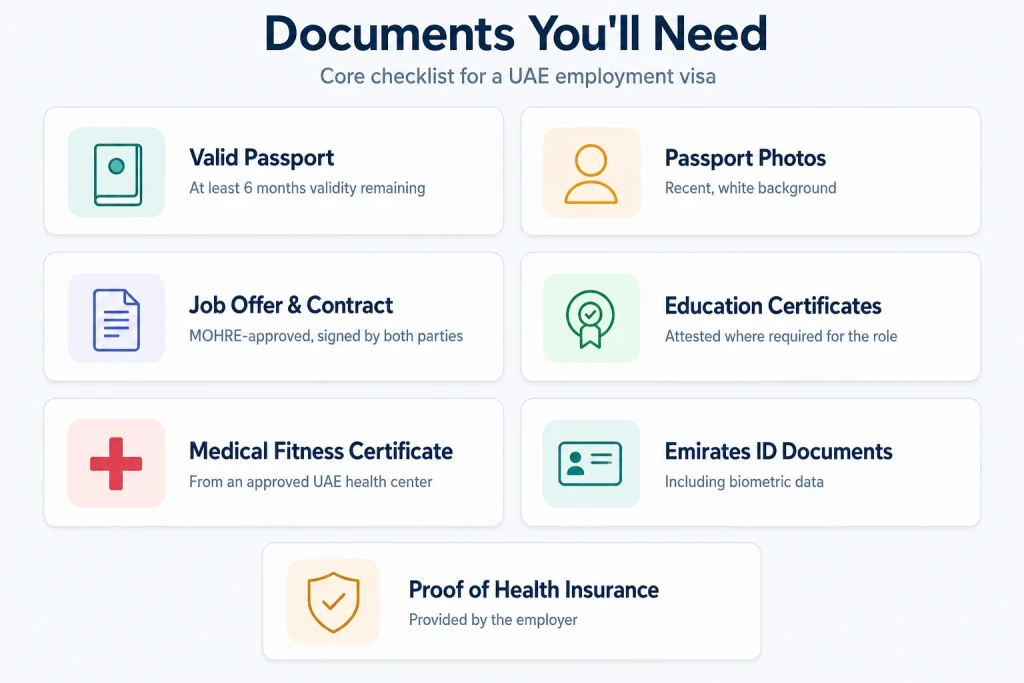
- A valid passport with at least six months left before it expires
- Recent passport-sized photos with a white background
- A MOHRE-approved job offer letter and signed employment contract
- Educational certificates, attested if required for your job (this means having them notarized in your home country, attested by the UAE embassy there, and finally verified by the UAE Ministry of Foreign Affairs)
- A medical fitness certificate from an approved UAE health center
- Emirates ID application documents, including your biometric data
- Proof of health insurance, which your employer is legally required to provide
The Step-by-Step Process
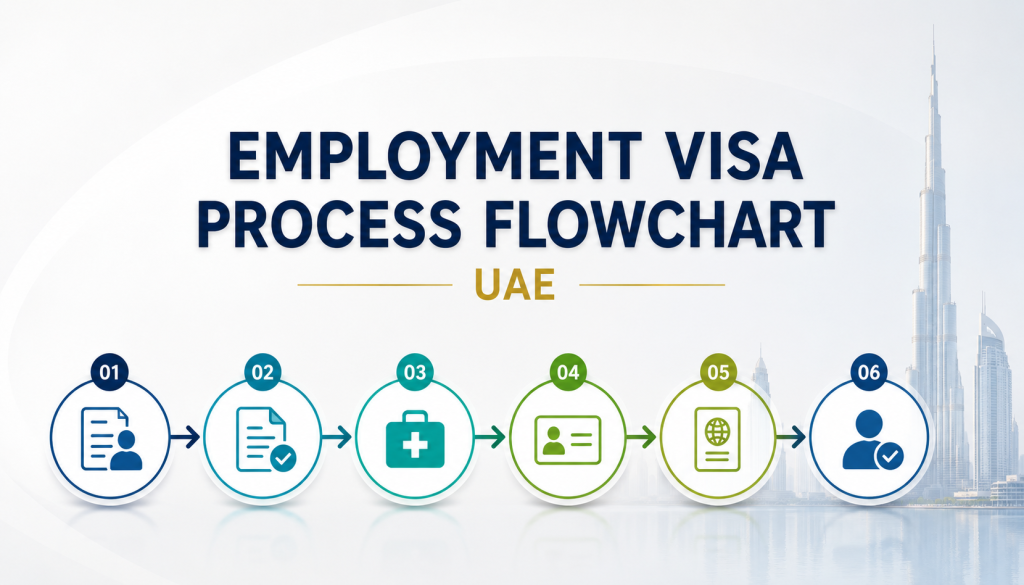
Here’s how the process usually works, from job offer to final work authorization:
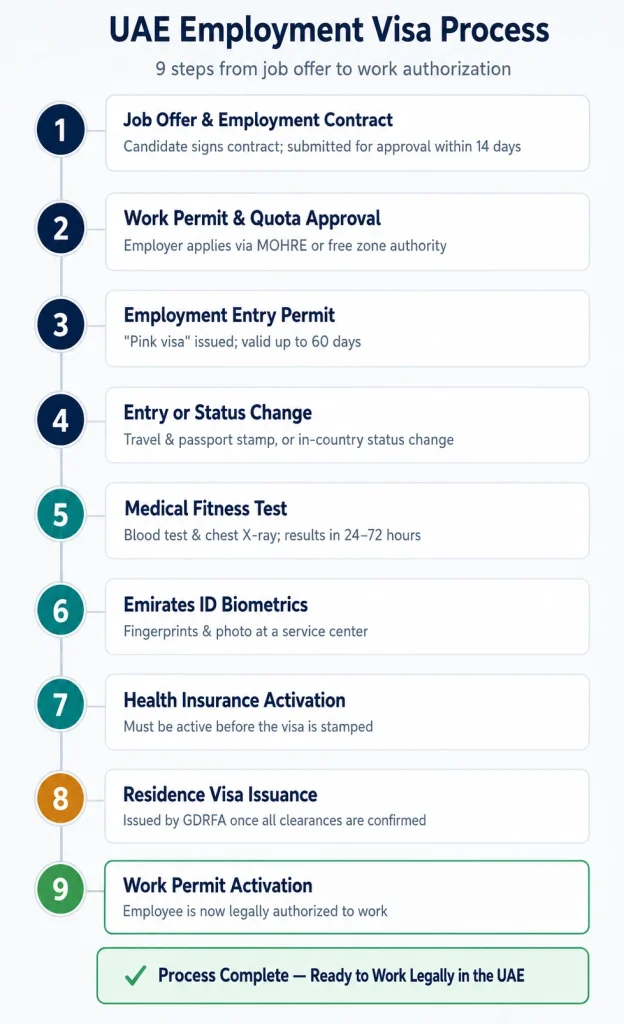
Step 1: Job Offer and Employment Contract
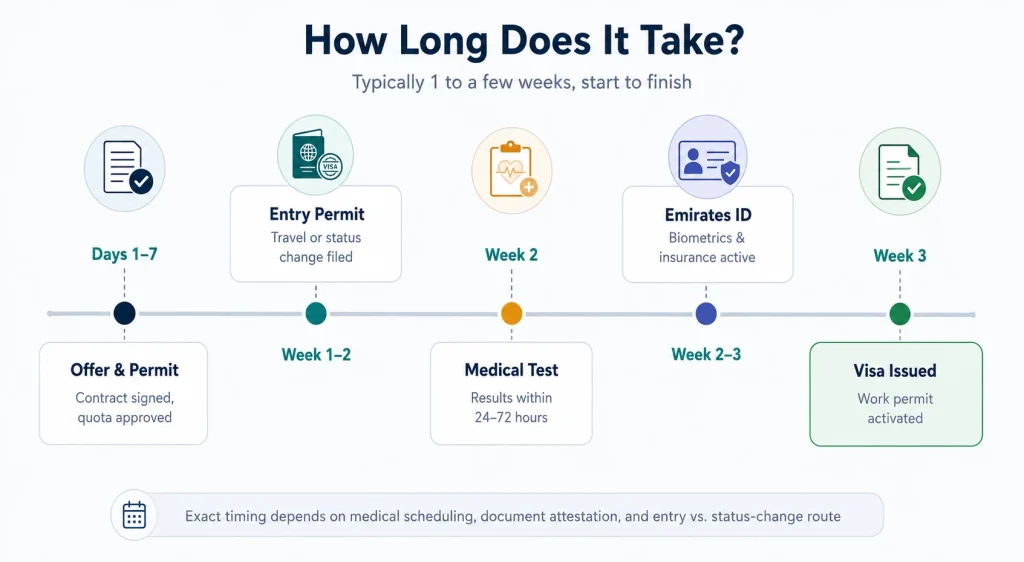
The process starts when a candidate receives a formal job offer from a UAE-licensed employer. Both sides sign a standard employment contract covering salary, benefits, allowances, and probation terms. This contract typically needs to be submitted for approval within 14 days of signing.
Step 2: Work Permit and Quota Approval
The employer applies for a work permit and quota approval through MOHRE (for mainland companies) or the relevant free zone authority. This confirms the company still has room in its foreign employee quota and is following wage protection rules.
Step 3: Employment Entry Permit
Once the work permit is approved, the applicant receives an employment entry permit, sometimes informally called a “pink visa.” This lets them travel to the UAE or stay there, if already on a visit visa for up to 60 days to finish the remaining steps. If they’re already in the UAE, the employer can usually apply for an in-country status change instead of requiring them to leave and re-enter.
Step 4: Entry or Status Change
The employee either travels to the UAE using the entry permit and gets their passport stamped on arrival, or if already there the employer files for a status change before the current visa expires.
Step 5: Medical Fitness Test
Shortly after arrival, the applicant must complete a mandatory medical exam at an approved government health center. This usually includes a blood test and a chest X-ray to screen for conditions like tuberculosis and other infectious diseases. Results are typically ready within 24 to 72 hours and go directly to immigration authorities.
Step 6: Emirates ID Biometrics
The applicant visits an approved service center to register for their Emirates ID, which involves fingerprinting and a photo. The Emirates ID is the UAE’s main identification card, needed for almost everything official from opening a bank account to signing a phone contract.
Step 7: Health Insurance Activation
Employers must provide health insurance by law, and this coverage needs to be active before the residence visa can be issued.
Step 8: Residence Visa Issuance
Once the medical clearance, Emirates ID processing, and insurance are all confirmed, the General Directorate of Residency and Foreigners Affairs (GDRFA) issues the residence visa. Depending on the emirate, this might now be a digital record linked to the Emirates ID rather than a physical passport stamp, following recent reforms.
Step 9: Work Permit Activation
The final step is activating the labor card and work permit. At this point, the employee is legally authorized to start working for their sponsoring employer.
How Long Does It Take?
Processing times have improved a lot thanks to digital government systems. The MOHRE work permit alone can now be issued in just a few days. Still, the full process from signed job offer to final work permit activation typically takes one to a few weeks. The exact timeline depends on things like medical test scheduling, document attestation, and whether the applicant needs a status change or a fresh entry.
Costs and Legal Protections
Under UAE labor law, employers must cover the full cost of an employee’s visa processing; they cannot deduct these fees from the employee’s salary. If anyone is asked to pay visa costs that should be covered by their employer, they can report it to MOHRE.
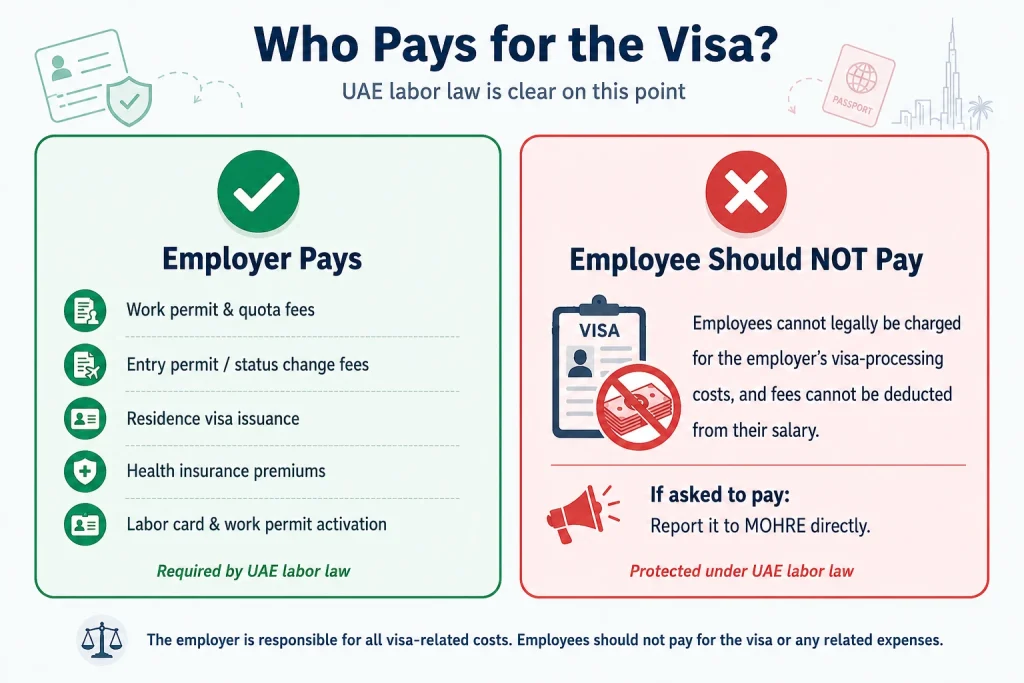
Actual costs vary depending on the company’s classification, the employee’s job category, and the specific emirate or free zone, so it’s best to confirm exact fees with your employer’s HR or PRO (Public Relations Officer) team.
Renewal and Validity
Standard employment residence visas are usually valid for two to three years, depending on the employment contract and sponsor. They can be renewed as long as the employment relationship continues and eligibility requirements are still met. Once issued, the Emirates ID becomes the main way to verify visa status, rather than a passport stamp.
Final Thoughts
Digital government initiatives have made the UAE employment visa process much smoother, but it still requires coordination across several authorities MOHRE, GDRFA or ICP, approved medical centers, and the Emirates ID authority. Whether you’re an employer sponsoring your first international hire or a professional preparing to relocate, understanding each step ahead of time can help you avoid delays and settle into life and work in the UAE more smoothly.






 SHARE YOUR REQUIREMENTS WITH US!


