


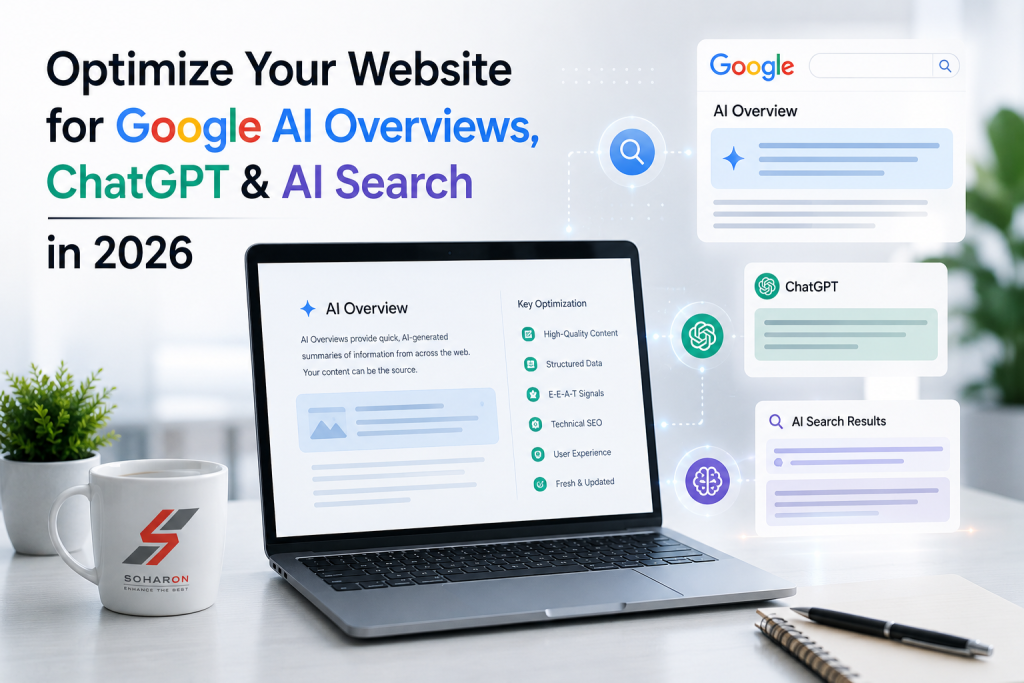
Search has quietly changed shape. A growing share of queries today never lead to a click at all; they’re answered directly inside Google AI Overviews, ChatGPT, Perplexity, and Microsoft Copilot. For any business that built its online presence around ranking for the “ten blue links,” that shift can feel unsettling. The reassuring part is this: the qualities that make a website trustworthy to a person: clear structure, real expertise, and genuine usefulness are the same qualities AI systems look for when deciding what to cite.
This guide walks through how AI search actually works, and the practical steps you can take so your website gets found, read, and quoted by the tools your customers are searching with today.
From Ranking to Being Cited
Traditional search hands the user a list of links and lets them do the work of comparing and clicking through. AI search skips that step entirely. Google AI Overviews, Google AI Mode, ChatGPT Search, and Perplexity all read across multiple sources, synthesize the most relevant facts, and hand the user one direct answer, with source links tucked below it rather than in front of it. If your content isn’t structured so these systems can lift and quote it cleanly, you don’t just rank lower, you disappear from the answer completely.
That’s the mindset shift agencies are talking about this year: stop asking “how do I rank higher?” and start asking “how do I become the source these systems trust enough to cite?” It’s a small change in framing that ends up reshaping how you write, structure, and maintain every page on your site.
The Six Pillars of AI Search Optimization
Generative Engine Optimization (GEO) builds on traditional SEO rather than replacing it. The tactics that get you cited by ChatGPT and the tactics that get you featured in a Google AI Overview overlap heavily and both reward accurate, well-organized content from a credible source. Six areas matter most.
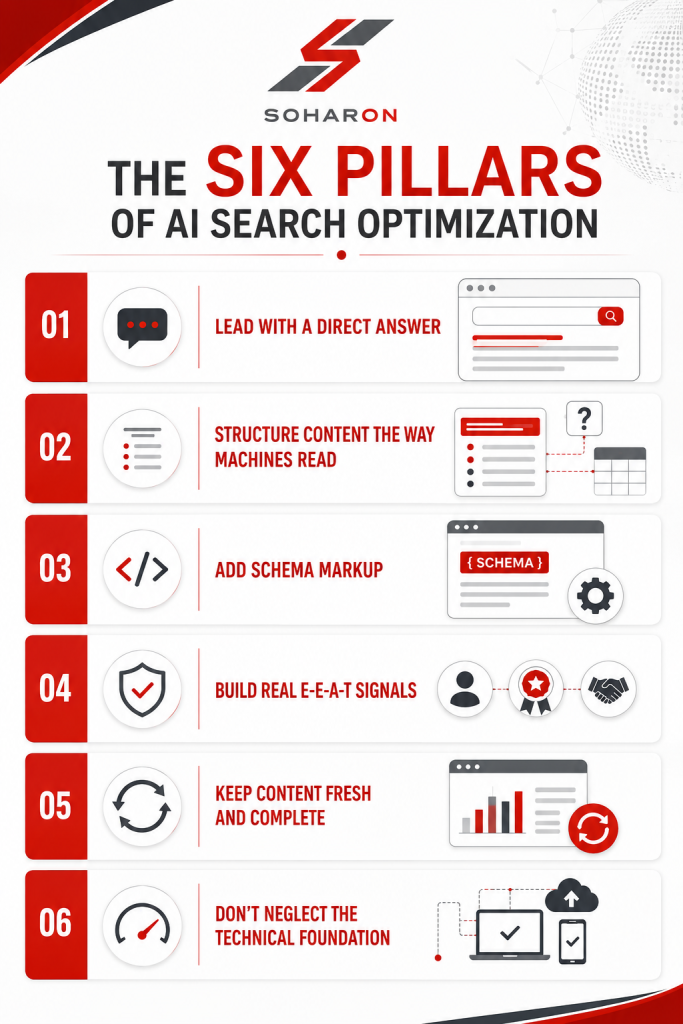
1. Lead with a direct answer
Open each section with a concise, self-contained answer in the first 40–60 words, something that could be lifted and quoted on its own. Follow it with supporting detail, examples, and context for readers who want more depth.
2. Structure content the way machines read
Use descriptive, question-based headings, short paragraphs, bulleted lists, and comparison tables. AI models parse structure to extract facts efficiently; a wall of unbroken text is far harder to lift a clean answer from.
3. Add schema markup
Structured data FAQ, Article, HowTo, and Organization schema turns your page into machine-readable content that tells AI tools what your business does and how trustworthy your content is. This is foundational work our SEO team builds into every technical audit.
4. Build real E-E-A-T signals
AI systems weigh experience, expertise, authoritativeness, and trust more heavily than keyword density. Author bylines, original data, case studies, and consistent brand mentions across credible third-party sites all reinforce that your content comes from a real, accountable source.
5. Keep content fresh and complete
Outdated statistics and stale examples quietly get passed over. Revisit your most important pages on a schedule, refresh figures, screenshots, and examples so AI systems have a clear reason to treat your page as the current best answer.
6. Don’t neglect the technical foundation
None of the above matters if your site can’t be crawled cleanly. Keep pages fast, mobile-friendly, and free of JavaScript-rendering issues, and make sure you’re indexed in both Google Search Console and Bing Webmaster Tools. Bing’s index feeds ChatGPT’s browsing results, so skipping it quietly closes off an entire channel.
Quick takeaway: AI systems reward the same qualities good editors always have: a clear point up front, evidence to back it up, and information that’s kept current. Structure and freshness now carry as much weight as backlinks once did.
Measuring What’s Working
Because AI answers rarely generate a click, standard analytics can make this work look invisible. Google Search Console now surfaces impression data tied to AI Overview appearances, and a growing number of tools track “share of voice” inside ChatGPT and Perplexity answers for your industry’s core questions. Watch for impression growth alongside a flat or falling click-through rate on informational queries; that combination is often a sign your content is being read and cited inside an AI answer, even without the click.
- Filter Search Console queries for AI Overview attribution to see where you’re already being surfaced
- Track branded search volume citations in AI answers tend to lift brand-name searches over time
- Monitor referral traffic from chat.openai.com, perplexity.ai, and copilot.microsoft.com separately from organic search
Why This Matters Now
This isn’t a trend to wait out. Traditional SEO isn’t dead, but it’s no longer sufficient on its own; the businesses gaining visibility this year are treating AI search optimization as a natural extension of their existing SEO and content strategy, not a separate project bolted on afterward. Getting there takes the same foundation Soharon Infotech builds for every client: technically sound websites, well-structured content, and an SEO strategy built to adapt as search itself keeps evolving.
Conclusion
AI search isn’t replacing SEO, it’s raising the bar on what good SEO actually looks like. The websites winning citations in 2026 are the ones built on clear structure, real expertise, and content that stays current. Start with your highest-traffic pages, tighten them against the six pillars above, and track your progress through AI Overview impressions rather than clicks alone. Get the foundations right, and your site won’t just rank — it’ll be the answer.
Frequently Asked Questions
Is AI search optimization different from regular SEO?
Not entirely it builds on the SEO basics you already have, like speed and clean site structure. It adds direct answers, schema markup, and clear expertise so AI models trust you enough to cite you.
Can a small business realistically compete for AI citations?
Yes, often more easily than in regular rankings. AI favors the clearest, most complete answer over the biggest brand name.
How long does it take to see results?
Expect roughly 8 to 12 weeks, similar to traditional SEO timelines. Sites with clean technical health tend to see citations appear sooner.
Do I need to rewrite my entire website?
No start with your top informational pages like services and blog posts. Add direct answers and schema there first; a full rebuild isn’t necessary.





 SHARE YOUR REQUIREMENTS WITH US!


