


Every business owner investing in digital marketing eventually faces the same critical question: Should I invest in SEO or Google Ads? It is one of the most debated topics in digital marketing, and for good reason — both strategies can drive traffic, generate leads, and grow your revenue. But they work in fundamentally different ways, deliver results on different timelines, and serve different business objectives.
At Soharon Infotech, we have managed both SEO campaigns and Google Ads strategies for over 300 clients across various industries. In this blog, we break down the real differences, the true cost of each, and — most importantly — which one delivers better ROI for your business.
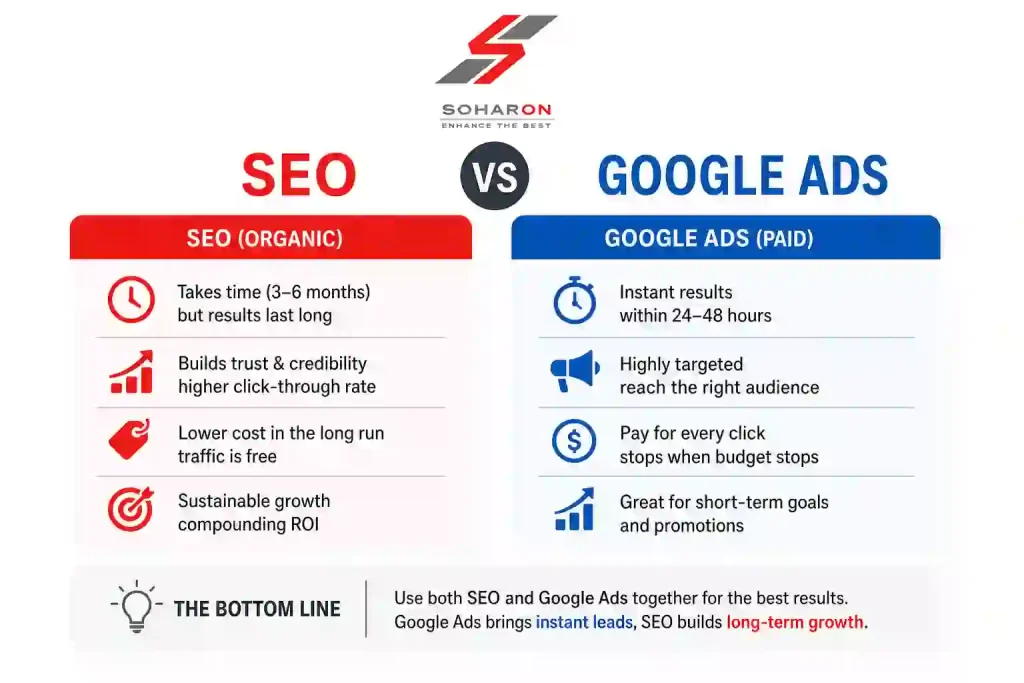
Understanding SEO: The Long Game That Pays Off
Search Engine Optimization is the process of improving your website’s visibility on Google’s organic search results. When someone searches for “interior design company in Dubai” or “best translation services UAE,” SEO is what puts your website on the first page — without you paying for every click.
SEO works by optimizing your website’s content, technical structure, and online authority. It involves selecting the right keywords, creating high-quality content, building credible backlinks, and ensuring your website is fast, mobile-friendly, and technically sound.
The defining characteristic of SEO is that its results compound over time. A well-optimized website continues to attract traffic months and years after the initial work is done. At Soharon, we have helped clients achieve over 650 ranked keywords and 70,000+ impressions — results that continue to generate leads without ongoing ad spend.
However, SEO does require patience. Most businesses begin seeing meaningful results within 3 to 6 months. It is not the right tool if you need immediate leads this week. It is, however, the most powerful strategy for building sustainable, long-term online visibility and authority in your industry.
Key advantages of SEO:
- Builds lasting organic visibility that does not disappear when budgets are cut
- Generates consistent, high-quality traffic over time
- Establishes brand credibility and trust — users trust organic results more than paid ads
- Delivers compounding ROI — the longer you invest, the greater the return
- Targets users at every stage of the buying journey
Understanding Google Ads: Immediate Visibility, Immediate Cost
Google Ads (formerly Google AdWords) is a pay-per-click (PPC) advertising platform that places your business at the very top of Google search results — instantly. You choose your keywords, set a daily budget, write your ad copy, and your ads appear immediately when people search for those terms. You pay each time someone clicks on your ad.
The biggest advantage of Google Ads is speed. Unlike SEO, which takes months to build momentum, a well-structured Google Ads campaign can start generating calls, form submissions, and sales within 24 to 48 hours of going live.
At Soharon, we have run Google Ads that generated 2,892 clicks, over 37,000 impressions, and 260+ conversions — delivering measurable results that business owners can see in real time. With the right Google Ads strategies in place, you can reach specific audiences with precise targeting based on location, device, search intent, demographics, and even the time of day.
However, even the most well-crafted Google Ads come with one fundamental limitation: the moment your budget runs out, your visibility disappears completely. There is no residual value. If you stop paying, you stop appearing. This makes it a continuous cost of doing business rather than a long-term investment that builds over time.
Key advantages of Google Ads:
- Instant visibility at the top of Google search results
- Highly targeted — reach the right audience at the right moment
- Fully measurable with clear data on clicks, conversions, and cost per lead
- Excellent for promotions, product launches, and time-sensitive campaigns
- Scalable — increase or decrease budget based on performance
SEO vs Google Ads: A Direct ROI Comparison
To answer the question of which delivers better ROI, it is important to understand that ROI in digital marketing is not just about short-term revenue — it is about the total value generated relative to the total investment made over time.
Cost Structure:
SEO involves an upfront investment in optimization, content creation, and ongoing maintenance, but the traffic it generates is essentially free. Google Ads requires a continuous financial commitment — every click costs money, and that cost scales with competition. In competitive industries in the UAE, cost-per-click can range from 5 AED to over 50 AED depending on the keyword.
Timeline:
Google Ads delivers results immediately. SEO delivers results gradually but those results grow and sustain themselves. A business that invests in SEO for 12 months will often find that its monthly organic leads far exceed what the same budget could generate through paid advertising.
Trust and Click-Through Rate:
Studies consistently show that users click on organic results more than paid ads. The majority of searchers skip past the paid listings and focus on the organic results — which means SEO traffic tends to be higher quality and more likely to convert.
Sustainability:
If you pause your SEO investment for a month, your rankings largely remain intact. If you pause your Google Ads, your traffic drops to zero immediately.
For businesses with immediate revenue needs — a new product launch, a seasonal promotion, or a business that launched yesterday — Google Ads is the right starting point. It puts you in front of customers today.
For businesses building long-term digital presence — those that want to own their market, reduce their cost per acquisition over time, and establish lasting authority — SEO delivers significantly superior ROI in the long run.
When to Use Both Together
Here is the truth that many agencies will not tell you: the most successful businesses in the UAE use both SEO and Google Ads — strategically, not simultaneously for the same keywords.
Google Ads can be used to generate immediate leads while your SEO strategy is building momentum. Once your organic rankings are established and delivering consistent traffic, you can reduce your ad spend on those keywords and redirect budget toward new markets or more competitive terms.
For example, a translation company we worked with used Google Ads to generate consistent daily leads while we simultaneously built their SEO from the ground up. Over 6 months, their organic traffic grew to the point where they could confidently scale back their ad spend and rely on organic results — reducing their monthly marketing cost significantly while maintaining lead volume.
This combined approach delivers the best of both worlds: immediate results from Google Ads and compounding long-term ROI from SEO.
Which One Is Right for Your Business?
There is no universal answer — it depends on your goals, timeline, budget, and industry. Here is a simple framework to guide your decision:
Choose Google Ads if you need immediate visibility, are launching a new business, running a time-sensitive promotion, or testing new markets quickly.
Choose SEO if you want to build long-term digital authority, reduce your cost per lead over time, and generate organic traffic that grows month after month.
Choose both if you want to dominate your market, accelerate growth now, and build a sustainable foundation for the future.
Conclusion
Both SEO and Google Ads have a place in a smart digital marketing strategy. But when it comes to long-term ROI, SEO wins — because it builds an asset that grows in value over time, rather than a service that stops working the moment the budget is exhausted.
At Soharon Infotech, we help businesses across Dubai and the UAE design the right combination of SEO and Google Ads strategies to achieve their growth goals — whether that means ranking #1 on Google, generating 260+ conversions through paid campaigns, or building a complete digital presence from scratch.
Ready to find out which strategy is right for your business? Contact Soharon Infotech today for a free consultation.




 SHARE YOUR REQUIREMENTS WITH US!


